
The 'secret sauce' for proximal hamstring tendinopathy rehab
Hey folks,
Aidan Rich et al. have published a really interesting trial comparing an exercise and education–based physiotherapy program with shockwave therapy for proximal hamstring tendinopathy (PHT).
First of all congrats to the team. It is a big and well conducted trial, which represents a massive amount of work.
I’m not going to dive into all the outcome details here. In short, there were no meaningful differences between the two groups over time.
What I want to focus on instead is how this fits with the way I manage PHT in the clinic, including what I would have done differently and why. I’ll break this down into five main critiques.
1. Too biomechanical, not enough about pain
The mechanisms described in the paper are almost entirely biomechanical and biological. They talk about improved voluntary activation, changes in muscle–tendon stiffness, increased tendon modulus, etc. This doesn’t really get to the root of why people experience pain. For many people (I’d argue most) tendon pathology has often been “brewing away” in the background for years. Yes, that involves matrix and biochemical changes. But we also know that plenty of people have these changes without any pain at all. So what actually tips someone into pain?
This is where things get more interesting. It might have nothing to do with a sudden change in activity or load. It could be a stressful life event, poor sleep, illness, work pressure, or something completely unrelated to training. Yet there’s almost nothing in this trial about psychosocial factors, stress, or broader life context. Where is the education around that?
2. Pain tolerance framed too cautiously
The trial talks about “hurt versus harm,” which is helpful to a point. They explain that low pain levels during activity aren’t dangerous and that 12–24 hour symptom response is the best guide to tolerance. But what’s not made explicit is that going beyond this “mild–moderate” pain framework isn’t inherently bad or harmful. And that matters, because many patients are already worried about what will happen if they push too far into pain.
I always explain that a flare (even really severe pain) is not the same as worsening pathology. Pain going up does not mean the tendon is being damaged. The way this is phrased in the paper still implies that exceeding a certain pain threshold carries risk:
“Hurt versus harm (i.e. that low pain levels during activity are not dangerous or indicative of damage to the tendon) and reiterate that latent (12–24 hours) pain with repeatable activities is the best indicator of tolerance to activity.”
The problem is that this can reinforce fear. Patients can walk away thinking, If I go beyond mild pain, I might be harming my tendon.
3. Too much emphasis on avoiding compression
There is way too much focus on reducing compression, avoiding stretching, and steering people away from hip flexion. In my view, this is fear-provoking. This links directly to the previous point. If people are already unsure what a pain flare actually means, and they’re also being told that hip flexion and compression can increase their symptoms, it doesn’t take Albert Einstein to work out what happens next: fear goes up.
And there’s some evidence of that in this study. They measured fear/psych factors using a couple of different questionnaires, and it didn’t really change. That’s surprising. The reassurance element from therapy, which is so powerful, seems to have been missing.
4. Isometrics reduced to “pain relief only”
The paper states that: “The use of isometric exercise in early management of PHT is recommended.” I used to be one of those experts who recommended isometrics mainly at the start of rehab. Now, I use them throughout. Isometrics are incredibly powerful, especially clinically, because they allow us to apply meaningful load early on – even when people are still battling symptoms. Stopping them once you “move on” to isotonics in a linear rehab model is, in my view, a missed opportunity.
In this trial, isometrics were mainly framed as having an analgesic role. That’s a shame, because it seriously downplays their broader value in building load tolerance and capacity.
These days I use an integrated rather than a linear model to treat people with tendon pain. If you’re interested in learning more about how I apply this in practice, there’s also a link to my online course here.
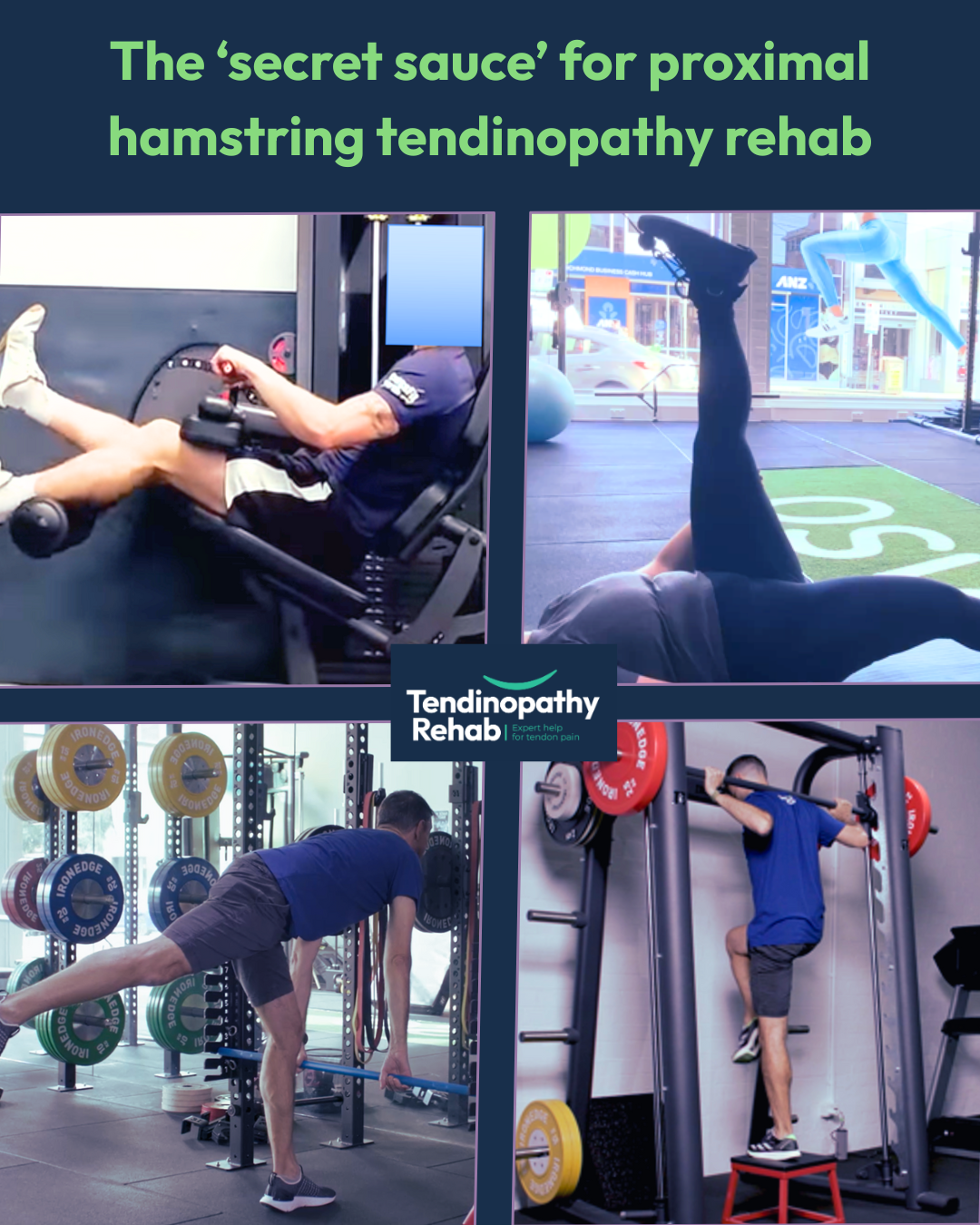
5. Not enough loading in hip flexion (the real “secret sauce”)
They only progressed into hip-flexion loading briefly (a few weeks at most) and then replaced it with more sport-specific activity. In my view, this is nowhere near enough progression into loading at longer muscle–tendon lengths. For me, the real secret sauce is hip flexion. It is the main event in proximal hamstring tendon rehab. That, combined with progressive stretch–shorten cycle loading.
There are lots of reasons for this. At longer hammy lengths (in hip flexion), you get the benefit of pre-stretching the connective tissue and, optimised the length–tension relationship. That means you can stack load and stack adaptations.
But it’s not just about biomechanics. There’s also a massive psychological benefit that often gets missed. When you give someone permission to load into hip flexion it builds confidence. It does the opposite of what fear-based avoidance does.
In over 20 years of giving second opinions on proximal hamstring tendinopathy, if there’s one thing that’s consistently underdone, it’s loading into length. Yes, eccentrics are important. We all do them. But isometric holds and progressive pushes into long-range positions? That’s the real secret sauce.
How do we load safely into flexion?
See some of my favourite hip-flexion progressions for PHT in the images below.
In my course, I explain exactly where to start and how to progress. For most people, I introduce hip-flexion loading early. Isometrics can usually be progressed much faster.
Thanks for reading
Peter

Connect with Prof Peter & the Team
Book a consultation
-
Visit Peter at our Richmond Clinic
-
Via a Telehealth session
-
132 Bridge Road, Richmond 3121, Melbourne Australia